Pond Pump Size Calculator
Find the ideal pond pump for your water feature. Enter your pond dimensions, plumbing details, and water feature type to get a tailored pump recommendation.
List of the Best Pond Pump:

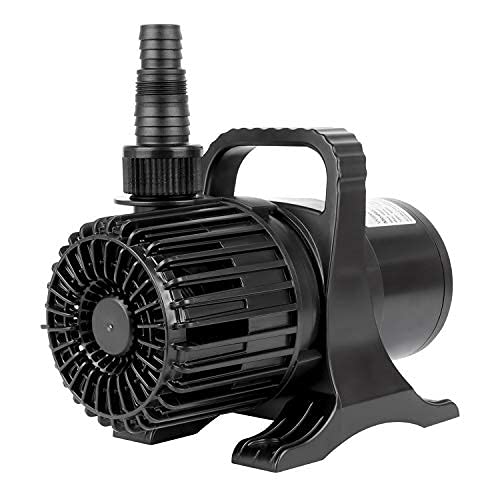
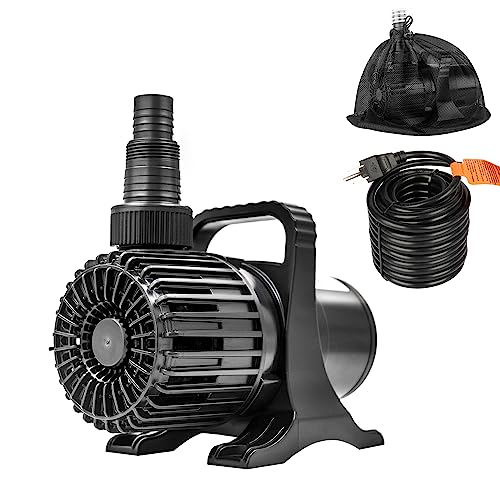
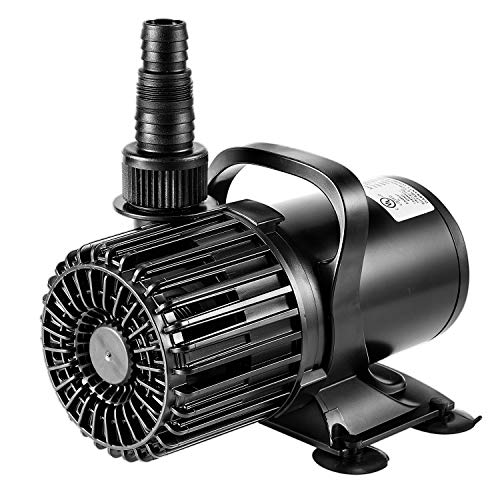


Pond Pump Sizing Guide – Everything You Need to Know
Why Proper Pump Sizing Matters
Choosing the right pond pump is critical for water quality, clarity, and the health of your fish and plants. An undersized pump leads to poor circulation, algae blooms, and stagnant water. An oversized pump wastes electricity, creates excessive turbulence, and can damage filters or piping. Our calculator helps you find the sweet spot: enough flow to turn over your pond water at least once every two hours, with sufficient head pressure to overcome plumbing friction and elevation gain.
Key Factors That Influence Pump Size
Pond Volume (Gallons)
Your pond’s total water volume is the starting point. To keep water clear, you need to circulate the entire volume through your filter system at least 1–2 times per hour. Larger ponds or koi systems often require 1.5–2 turnovers per hour.
Total Dynamic Head (TDH)
TDH is the sum of vertical lift (elevation difference) and friction losses from pipes, fittings, and valves. Every 10 feet of horizontal pipe adds roughly 1 foot of equivalent head, and each 90° elbow adds about 1.5 feet. Our calculator estimates TDH using standard coefficients.
Pipe Diameter & Length
Narrow or long pipes create significant friction loss. Increasing pipe size by one inch can reduce head loss by 50% or more. For pumps over 3000 GPH, 1.5" or 2" piping is recommended to maintain efficiency.
Water Feature Type
Waterfalls need higher flow for visual impact (100 GPH per inch of waterfall width). Fountains require pressure-rated pumps. Koi ponds need heavy aeration and filtration, often requiring 2× turnover per hour. We adjust the flow target based on your selection.
Pump Types & Their Applications
| Pump Type | Best For | Head Capability | Efficiency | Typical Usage |
|---|---|---|---|---|
| Submersible (Direct Drive) | Small to medium ponds, fountains | Up to 25 ft | Medium (65-75%) | Easy installation, quiet |
| Submersible (Magnetic Drive) | Skimmers, small waterfalls | Up to 12 ft | Low (50-60%) | Low maintenance, oil-free |
| External / Centrifugal | Large ponds, high-head applications | Up to 50+ ft | High (80-88%) | Powerful, energy-efficient |
| Variable Speed (ECM) | Energy-conscious, adjustable flow | Varies | Very high (85-92%) | Smart control, quiet |
Step-by-Step Sizing Method
1. Calculate Pond Volume
- Length × Width × Depth × 7.48 = Gallons (rectangular)
- For irregular shapes, use average dimensions
- Our calculator does this automatically
2. Determine Turnover Rate
- Standard ponds: 1× per hour
- Koi or heavy stock: 2× per hour
- Waterfalls: 1.5× per hour for visual effect
3. Estimate Head Loss
- Vertical lift: measure from water surface to discharge
- Friction: 1 ft per 10 ft of pipe, 1.5 ft per elbow
- Add 20% safety margin for aging pipes
4. Match Pump Curve
- Check manufacturer's curve for flow at your TDH
- Choose pump that meets target GPH at calculated head
- Oversize by 10-20% for future additions
Pump Sizing Examples
Small Garden Pond (10×6×3 ft)
Volume: ~1350 gal. Target flow: 1350 GPH. 1" pipe, 30 ft horizontal, 4 ft vertical lift → TDH ≈ 8 ft. Recommended pump: 1500 GPH @ 8 ft head (submersible magnetic drive).
Koi Pond (20×12×4 ft)
Volume: ~7180 gal. Target flow: 14,000 GPH (2× turnover). 2" pipe, 50 ft horizontal, 6 ft lift → TDH ≈ 12 ft. External pump: 15,000 GPH @ 12 ft head (centrifugal).
Waterfall Feature (3 ft wide)
Need 100 GPH per inch → 3600 GPH. 1.5" pipe, 20 ft horizontal, 8 ft lift → TDH ≈ 11 ft. Pump: 4000 GPH @ 11 ft head (submersible high-head).
Frequently Asked Questions
How do I know if my pump is too small?
Signs include: green water (algae), debris settling on bottom, fish gasping at surface, waterfall trickling rather than flowing, and filter clogging frequently. If your pump runs continuously and still can't keep up, it's time to upsize.
Can I use a submersible pump for a waterfall?
Yes, but ensure it's a "high-head" model. Standard submersibles lose flow quickly with elevation. Look for pumps rated for at least 1.5× your vertical lift. Many waterfall pumps are specifically designed for this.
How much electricity does a pond pump use?
Typical pumps range from 50W (small magnetic) to 1500W (large external). Our calculator estimates wattage based on flow, head, and efficiency. Variable-speed pumps can cut energy use by 50-70% compared to single-speed models.
Should I oversize my pump for future expansion?
It's wise to oversize by 10-20% if you plan to add a waterfall, fountain, or more fish. However, avoid over-oversizing – excessive flow can stress fish and waste energy. Use a valve to throttle if needed.
How often should I run my pond pump?
For most ponds, 24/7 operation is recommended to maintain biological filtration and oxygen levels. However, if you have a skimmer and UV, you can reduce to 12-16 hours in winter when fish are dormant.
What is the best pipe size for my pump?
As a rule: up to 2000 GPH → 1" to 1.25". 2000–4000 GPH → 1.5". 4000–8000 GPH → 2". 8000+ GPH → 2.5" or 3". Larger pipe reduces friction and allows your pump to operate at peak efficiency.
Maintenance & Longevity Tips
| Task | Frequency | Steps | Benefit |
|---|---|---|---|
| Clean intake strainer | Weekly (high debris) | Rinse with hose, remove leaves/debris | Prevents cavitation and flow loss |
| Check impeller | Every 3 months | Remove, clean, inspect for wear | Maintains flow rate |
| Lubricate seals (externals) | Annually | Use food-grade grease on O-rings | Prevents leaks |
| Winter storage | Seasonal (cold climates) | Remove, clean, store in frost-free area | Prevents freezing damage |
| Check voltage & wiring | Biannually | Look for corrosion, secure connections | Safety & efficiency |
Troubleshooting Common Pump Problems
Pump runs but no flow
Causes: Air lock, clogged impeller, closed valve, broken impeller shaft.
Solutions: Prime the pump, clean strainer, open all valves, replace impeller if seized.
Low flow rate
Causes: Clogged filter, pipe friction, undersized pipe, worn impeller.
Solutions: Clean filter, increase pipe size, replace impeller, check for kinked hoses.
Excessive noise or vibration
Causes: Cavitation, loose mounting, debris in impeller, bearing wear.
Solutions: Check for air leaks, secure pump base, clean impeller, lubricate bearings.
Pump trips GFCI / breaker
Causes: Water in electrical housing, damaged cord, overloaded circuit.
Solutions: Dry and seal connections, replace cord, use dedicated circuit for large pumps.